
Why Pool Leaks Can Be Difficult to Find
A swimming pool can lose water for several reasons, and not every drop points to a leak. Evaporation, splash-out, and backwashing can all lower the water level. When water loss is greater than expected, however, finding the source may take more than a visual inspection. Leaks can occur in the pool shell, plumbing lines, fittings, skimmers, or equipment, and some are hidden underground or behind surfaces.
Specialized pool leak repair tools help technicians investigate these possibilities systematically. Instead of digging or removing finishes based on guesswork, they can gather evidence, narrow down the location, and choose a repair that suits the problem.
- Leaks may be too small or concealed to see with the naked eye.
- Water can travel from the original leak before appearing somewhere else.
- Different leak locations require different testing and repair methods.
What Specialized Pool Leak Repair Tools Do
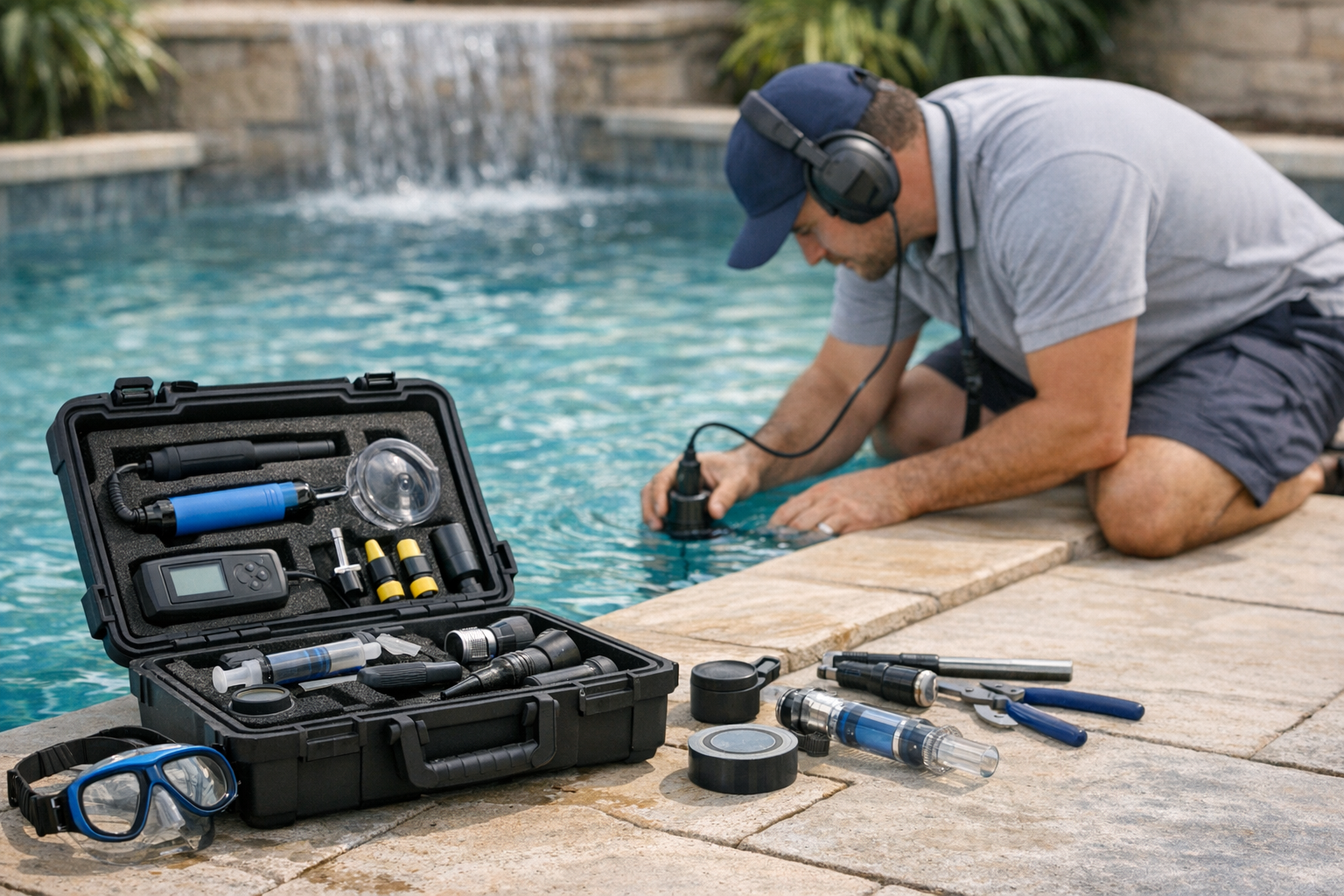
Pool leak detection tools are designed to test specific parts of a pool system. Some help identify whether water is escaping from plumbing; others help locate a leak in the pool shell or around an individual fitting. Used together, these tools make it easier to distinguish a plumbing issue from a structural one.
Testing is usually a process rather than a single measurement. A professional may start by documenting water loss and inspecting visible components, then use targeted equipment to confirm where the leak is occurring. The findings help guide the repair and can reduce unnecessary disruption to the pool area.
- Pressure-testing equipment can help assess whether an isolated plumbing line holds pressure.
- Dye testing tools help show whether water is being drawn through a suspected crack or fitting.
- Electronic listening devices can help detect sounds associated with escaping water in plumbing.
- Underwater cameras and inspection tools can make it easier to examine hard-to-see areas.
Common Tools Used to Locate Pool Leaks
Pressure Testers for Pool Plumbing
Pool plumbing often runs beneath decks or landscaping, so a leak in a pipe may not be visible at the surface. A pressure test helps evaluate a particular line, such as the return, suction, or cleaner line. The technician isolates the line and checks whether it maintains pressure under the test conditions. A result can point to a problem in that section, although additional testing may be needed to pinpoint the exact spot.
- Helps separate plumbing problems from leaks in the pool shell.
- Can narrow the investigation to a specific line or section.
- Reduces the need to disturb multiple areas without clear evidence.
Dye, Listening, and Visual Inspection Tools
For a suspected leak in the pool itself, dye testing can reveal water movement near a crack, light, drain, or fitting. Listening equipment may help detect escaping water in pipes, especially when the leak is not visible. Cameras, mirrors, and purpose-built inspection tools also help technicians examine confined or submerged areas more carefully.
- Dye testing is most useful when water is relatively still and the suspected area is accessible.
- Listening tools can help investigate concealed plumbing, but results need to be interpreted in context.
- Visual inspection remains important because tools support, rather than replace, experienced judgment.
Benefits of Using the Right Equipment
Specialized tools can make leak diagnosis more accurate and the repair process more efficient. Without suitable testing, a pool owner might patch a visible crack that is not the main source of water loss, or pay to expose a pipe that is functioning properly. Targeted diagnostics help focus work on the most likely cause.
Accurate detection can also protect the surrounding property. A persistent leak may saturate soil, affect nearby landscaping, or contribute to movement around a deck. Identifying the source early gives an owner a chance to address the issue before it leads to more extensive repairs.
- Less guesswork: Evidence helps guide the repair plan.
- Less disruption: Focused testing may limit unnecessary digging or surface removal.
- Better repair decisions: Knowing the leak location and type helps match the repair to the problem.
- Clearer communication: Test results can help explain what needs attention and why.
Why DIY Leak Detection Has Limits
Some basic checks are reasonable for pool owners. You can note the water level, look for damp spots, inspect visible equipment, and perform a bucket test to compare pool water loss with evaporation. These steps can help establish whether further investigation is worthwhile, but they usually cannot identify a concealed leak on their own.
Advanced testing also requires the right setup and interpretation. Incorrectly isolating plumbing, applying unsuitable pressure, or misreading a test may lead to false conclusions or damage. If water loss continues, or a leak may be beneath a deck or underground, a qualified pool leak professional is generally better equipped to investigate safely.
- Start by recording water loss under consistent conditions.
- Check visible fittings, equipment, and the pool perimeter for obvious signs.
- Avoid cutting, digging, or applying pressure to plumbing without the right knowledge and equipment.
- Ask a technician which tests are planned and what each test can establish.
Choosing a Pool Leak Repair Professional
Having specialized tools is valuable, but equipment alone does not guarantee a reliable diagnosis. Look for a professional who can explain the testing process, describe the limits of the results, and provide a clear repair recommendation. Experience with different pool types and plumbing layouts is also useful, since the best approach can vary from one pool to another.
- Ask whether the technician tests both the pool structure and relevant plumbing.
- Request a written summary of the suspected leak location and recommended repair.
- Confirm that the proposed repair addresses the cause rather than only the visible symptom.
Conclusion
Specialized pool leak repair tools help turn a frustrating search into a focused diagnosis. Pressure testers, dye, listening devices, and inspection equipment each serve a purpose, and skilled professionals use their results together to guide repairs. When basic checks do not explain ongoing water loss, the right tools—and the experience to use them—can help protect your pool and avoid unnecessary work.